Scientific Srinivas's brain child: “Scientific Motivational Demonstrations” (SMD)
Objectives
The Scientific Motivational Demonstrations (SMD) program is designed to:
- Develop scientific temperament, curiosity, and a questioning attitude among students.
- Inspire children to think creatively, critically, and innovatively.
- Connect classroom science with real-life applications through live demonstrations.
- Introduce students to Science, Engineering, Technology, Innovation, and Entrepreneurship.
- Encourage students to identify problems in society and develop practical solutions.
- Promote awareness of renewable energy, energy conservation, and sustainable development.
- Motivate students to become future scientists, engineers, innovators, entrepreneurs, and responsible citizens.
- Enhance students' observation, analytical, and problem-solving skills through interactive learning.
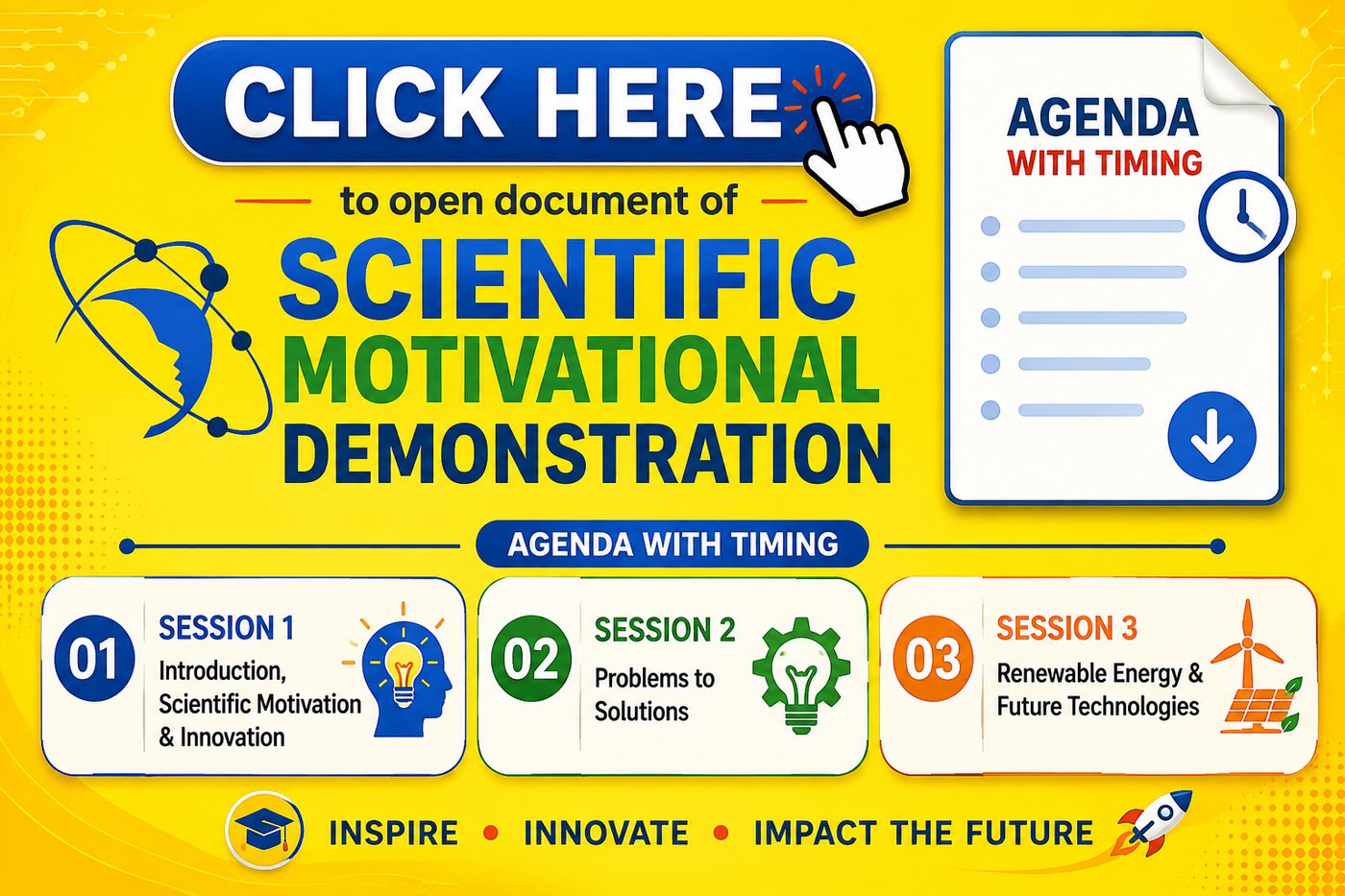
Agenda with Timing
01
Session 1 – Introduction, Scientific Motivation & Innovation
0:00 – 1:00 hourWarm-up & interaction (first few minutes)
- Interactive session with students.
- Introduction to the SMD program.
- Ice-breaking activities to ensure active participation.
- Creating an energetic and curiosity-driven learning environment.
Scientific motivation
If a projector or interactive flat panel display is available, the session begins with the specially designed Scientific Motivational Demonstrations (SMD Version 2.0) PowerPoint presentation. Topics include:
- Importance of Science, Engineering and Technology.
- Role of scientists, engineers and entrepreneurs in nation building.
- Scientific thinking and innovation.
- Inspiring stories of inventions and innovations.
- Live demonstrations using innovative working models.
02
Session 2 – Problems to Solutions
1:00 – 1:45 hourThis highly interactive session focuses on converting problems into innovative solutions.
Students will:
- Learn the process of identifying real-world problems.
- Understand design thinking and innovation.
- Observe 15–20 innovative working models developed to solve various local, national, and global challenges.
- Experience how simple scientific principles can lead to impactful inventions.
The emphasis is on:
CreativityProblem-solvingInnovationPractical application of science
Tea Break
1:45 – 1:55 hour (10 minutes)
03
Session 3 – Renewable Energy & Future Technologies
2:00 – 3:00 hoursThis session explores one of the world's greatest challenges: energy.
Topics include:
- Different forms of energy.
- Fossil fuels and their environmental impact.
- Renewable energy sources.
- Solar and wind energy technologies.
- Energy conservation and sustainability.
Students will experience:
- Demonstration of around 30 innovative renewable energy models and products.
- Hands-on understanding of specially designed Solar Power Managers.
- Practical concepts of electricity generation, storage, and utilization.
- Power budgeting and electricity calculations using uniquely designed educational gadgets.
- Real-life applications of renewable energy technologies.
The session concludes with motivating students to become future innovators capable of designing sustainable technologies for society.
Expected Outcomes
By the end of the SMD program, students will:
- Develop a stronger scientific mindset.
- Improve critical and creative thinking abilities.
- Gain confidence in solving real-world problems.
- Understand innovation as a continuous process.
- Appreciate renewable energy technologies and sustainability.
- Feel inspired to pursue careers in Science, Engineering, Technology, Innovation, and Entrepreneurship.
- Become more responsible, environmentally conscious, and solution-oriented citizens.