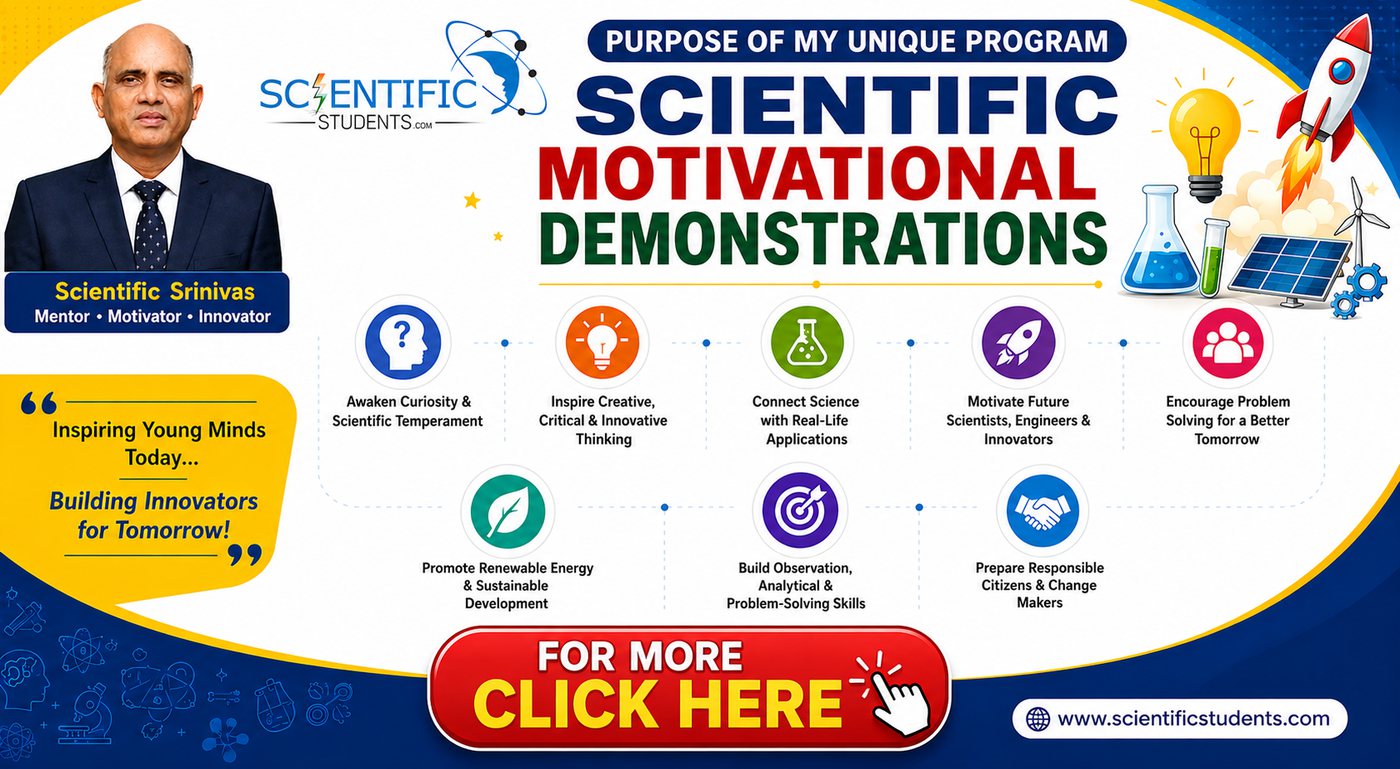
Purpose of Scientific Motivational Demonstrations (SMD Ver. 2.0)
According to me, scientists are the architects of human progress. They discover the fundamental principles of nature, transform them into practical technologies, and make life better for humanity. Scientists are innovators who develop solutions to simple, complex, and critical challenges faced by both living and non-living systems. Their discoveries create knowledge, generate wealth, and become the foundation for the progress of society.
This raises an important question:
How can we nurture scientific thinking in children from their school days?
How can we cultivate curiosity, creativity, and the courage to question?
The scientist is not a person who gives the right answers; he is the one who asks the right questions.— Claude Lévi-Strauss
Inspired by this philosophy, I constantly ask myself:
- How do we help children think more effectively?
- How do we make thinking visible?
- How do we make science learning joyful and memorable?
- How do we nurture inquisitive young scientists?
- How do we inspire innovative designers and creative engineers?
- How do we encourage children to dream beyond limitations and achieve the seemingly impossible?
- How do we empower them to explore the unknown and discover the untold?
These questions become even more significant when we reflect on India's scientific journey.
- Why have we produced no Nobel laureates in science since Sir C. V. Raman?
- Why is India's contribution to high-impact scientific research still far below its true potential?
- What qualities and environment are necessary to nurture world-class scientists?
The legendary scientist Dr. Yellapragada Subba Rao believed that:
A scientist's creativity and originality flow from the freedom of thought enjoyed by him.— Dr. Yellapragada Subba Rao
Similarly, Dr. A. P. J. Abdul Kalam inspired millions by proving that great dreams, combined with scientific thinking and perseverance, can transform a nation. The real challenge before us is:
How do we inspire and produce many more Kalams, Ramans, Nayudammas, and Subba Raos?
With these thoughts and as part of my social responsibility, I conceived and developed Scientific Motivational Demonstrations (SMD Ver. 2.0), a unique educational initiative that transforms science into an exciting, interactive, and inspiring learning experience.
Why a little more focus on Physics?
Among all science subjects, I observed that many students develop a fear of Physics. Although they often score highly in Mathematics and Chemistry, Physics becomes a major obstacle in competitive examinations and admission to premier institutions such as the IITs and NITs.
To address this challenge, I have designed a series of carefully structured scientific demonstrations that connect almost every major concept and chapter of Physics with real-life experiences. Instead of merely listening to explanations, students witness scientific principles in action through engaging, hands-on demonstrations.
This approach helps students:
- Eliminate the fear of Physics.
- Develop conceptual understanding instead of rote memorization.
- Learn science through observation, experimentation, and participation.
- Build confidence in applying scientific principles.
- Experience the joy of learning through curiosity and discovery.
One of the greatest strengths of demonstrations is that they naturally provoke questions such as:
“How does this work?”
The moment children begin asking such questions, the journey of scientific thinking begins.
Science demonstrations make even complex concepts simple, memorable, and enjoyable. They ignite curiosity, stimulate critical thinking, and encourage students to explore beyond textbooks.
One such innovative initiative under this program is Children CircuitLab, a unique gadget-based demonstrative session where students learn electronics, circuits, sensors, and scientific principles through live experimentation and interactive activities.
My vision is not merely to teach science, but to inspire scientific minds: young minds that question, explore, innovate, create, and ultimately contribute to building a scientifically progressive and self-reliant India.